
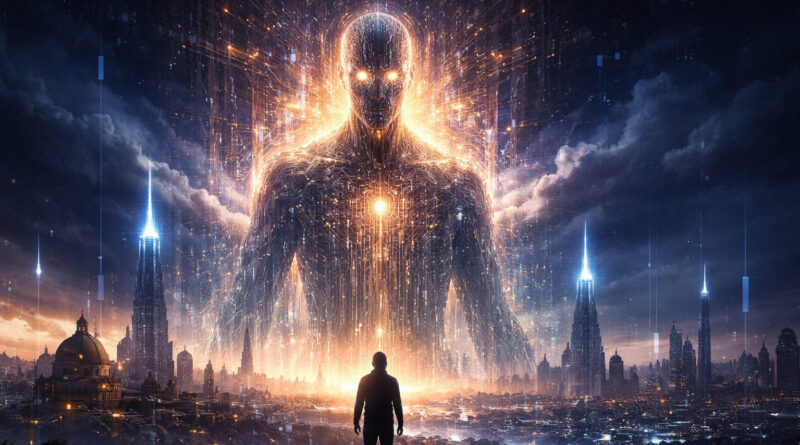
Does the Bible mention AI? (I)
Wait… Are We the Only Ones Who Thought of AI?
I wasn’t trying to think about artificial intelligence.
That’s probably the first thing I should say, just to establish that this wasn’t one of those late-night internet spirals where you start with “what is AI?” and end up convinced your toaster is judging you. This was supposed to be a normal, sensible, spiritually grounded activity: reading the Bible.
Specifically, Revelation.
Which, in hindsight, is not where you go if you want your thoughts to remain calm and linear.
Anyway, somewhere between beasts, horns, and things that definitely don’t behave like normal animals, I had a slightly irritating thought. The kind that arrives uninvited and then refuses to leave.
This sounds… structured.
Not structured like poetry. Not structured like metaphor. Structured like… a system.
And once that thought landed, my brain did what it always does: it started pattern matching. Which, ironically, is also what AI does. So this may already be compromised.
Let me be clear upfront before this goes off the rails. I’m not claiming the Bible predicts artificial intelligence. I’m not about to identify ChatGPT in a Greek verb or suggest Moses was debugging code on Sinai. That would be… excessive.
What I am saying is that when you strip things back – remove the modern labels, ignore the shiny interfaces, and just look at the underlying concepts – you start to notice that Scripture already has categories for things that feel… adjacent.
Not identical. Not literal. But uncomfortably close in structure.
And that’s where things start to get interesting.
Ground Rules (So We Don’t Lose the Plot)
Before going any further, we need constraints. Without constraints, this becomes one of those theories that can “prove” anything if you squint hard enough.
So here are the rules I’m trying to stick to:
- No forcing modern technology into ancient text.
If something only works because I’ve retrofitted a 21st-century idea into a 1st-century sentence, it doesn’t count. - Respect the original context.
The Bible was written to real people in real historical situations. If an interpretation ignores that, it’s probably wrong. - Allow for symbolism without making it meaningless.
Especially in apocalyptic writing (Daniel, Revelation), things are symbolic – but not random. Symbols point to real structures, real systems, real dynamics. - Look for patterns, not predictions.
This isn’t about “the Bible predicted AI.” It’s about whether the Bible describes types of things that could include something like AI.
If you’re familiar with software development, this is basically the difference between hardcoding values and defining abstractions. We’re not looking for “AI.exe” in Scripture. We’re looking for the underlying architecture.
So… What Is AI, Really?
We should probably define AI before trying to find it in a 2,000-year-old text. That seems like a reasonable step.
If you strip away the hype, branding, and existential panic, AI (at least as we currently have it) boils down to a few key ideas:
- Pattern recognition at scale
- Decision-making without direct human input
- Systems that can act in ways that feel… intentional
That last one is important. AI doesn’t have consciousness (despite what headlines might imply), but it produces outputs that look like they came from something that understands.
Which creates a slightly weird category:
Something that behaves like an intelligence, without being human.
Now, historically, that’s not actually a new idea.
Scripture Already Has Categories for This
This is where things started to feel less comfortable for me.
Because the Bible is not unfamiliar with the concept of non-human agents operating with intelligence or authority.
Take angels, for example.
Angels in Scripture:
- Deliver messages
- Execute judgments
- Act with autonomy (to a degree)
They are not human, but they are intelligent agents. They operate within a system of authority, but they can act independently in specific contexts.
That’s already a category: non-human intelligence with delegated authority.
Then there’s another category – arguably stranger.
Idols.
Now, idols in the Bible are repeatedly described as:
- Having mouths but not speaking
- Having eyes but not seeing
- Being treated as if they were alive
There’s a kind of tension there. On one hand, they are explicitly lifeless. On the other hand, people interact with them as if they have agency.
Which raises an odd question:
What happens when something that isn’t alive starts behaving as if it is?
The Bible doesn’t answer that directly in the context of technology (for obvious reasons), but it clearly recognises the conceptual space.
And then there’s a third layer.
Systems That Behave Like Minds
One of the more overlooked patterns in Scripture is how often systems are described as if they were individual actors.
Empires are portrayed as beasts. Kingdoms rise, fall, speak, act, demand.
In Daniel and Revelation especially, you don’t just get individuals making decisions – you get entire structures behaving like unified entities.
If I were to describe that in modern terms (which I’m slightly hesitant to do, but here we are), I’d say:
The Bible is comfortable describing distributed systems as if they were single intelligences.
Now, that doesn’t mean those systems are conscious. But they behave in ways that are coherent, directed, and purposeful.
Which, again, feels… familiar.
The Slightly Uncomfortable Overlap
So let’s summarise where we’ve got to so far:
- The Bible includes non-human intelligences (angels)
- It acknowledges lifeless objects treated as agents (idols)
- It describes systems behaving like unified minds (beasts/empires)
None of these are AI.
But if you were trying to explain AI – without the words, without the technology, without the context – you might end up describing something that overlaps with those categories.
Something that:
- Isn’t human
- Isn’t alive (in the biological sense)
- But can act, decide, and influence
At this point, I’m not drawing conclusions. I’m just noting that the conceptual framework already exists.
Which means, at the very least, the Bible wouldn’t be confused by the idea of AI.
It already has mental “buckets” for things like that.
A Few Early “That’s… Interesting” Moments
I’m not going to go deep into specific passages yet – that’s Part 2, where things get a bit more intense – but there are a couple of moments worth flagging.
For example:
- Daniel talks about knowledge increasing in the last days
- Revelation describes things that look constructed but behave alive
- There are repeated warnings about deception at scale
None of these explicitly point to technology.
But they do describe conditions where:
- Information expands rapidly
- Systems influence large populations
- People interact with things that aren’t what they appear to be
Which, again, is… at least adjacent.
So… What Am I Actually Saying?
At this point, it would be very easy to either overstate this or dismiss it entirely.
I’m trying to do neither.
I’m not saying:
- “The Bible predicted AI”
- “Revelation is about machines”
- “We’re living in a sci-fi fulfilment of prophecy”
That would be a stretch. A big one.
What I am saying is this:
The Bible already contains categories that make the idea of AI conceptually unsurprising.
And that’s a different claim.
It means that if something like AI becomes significant in human society (which it already is), Scripture doesn’t suddenly become irrelevant or silent. It already speaks in terms of:
- Authority
- Agency
- Influence
- Systems that shape human behaviour
AI, at its core, fits into those conversations.
Not as a named entity.
But as a possible instance of a broader pattern.
Closing Thought (Before This Escalates)
I’ll be honest – when I first had this thought, I was hoping it would go away if I ignored it.
It didn’t.
And the more I looked, the more I realised that the question isn’t:
“Does the Bible mention AI?”
That’s probably the wrong question.
The better question might be:
“Does the Bible describe the kind of world where something like AI would make sense?”
And the answer to that… is at least worth exploring.
Even if it does make reading Revelation slightly more unsettling than it already was.