
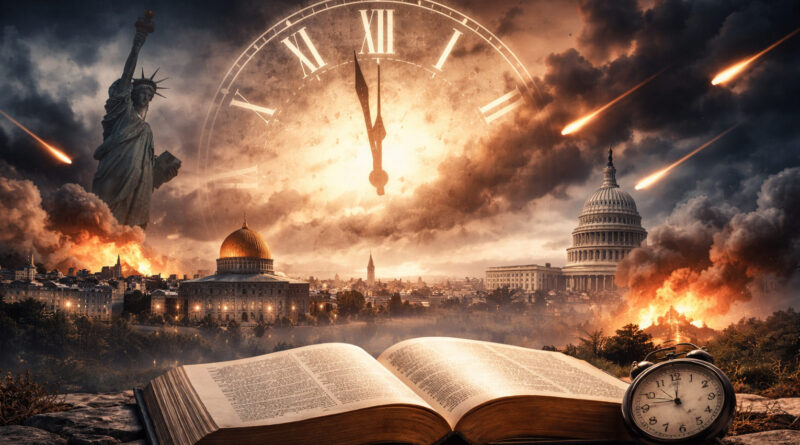
Is Trump the Beginning of the End? – One Year on
Last year I wrote an article asking whether Donald Trump might, in some sense, represent the beginning of the end. It was a deliberately provocative question, but it was never intended as a prediction. The aim was not to claim certainty, set dates, or force current events into a prophetic scheme. It was simply to ask whether certain developments in the world, and especially in leadership, lawlessness, and the Middle East, were beginning to move in a direction that Bible readers might reasonably recognise.
The response to that article was striking. Many readers found it thought-provoking. Some agreed with the general trajectory. Others felt parts of it went too far, or moved too quickly from possibility to implication. That is fair. When writing about prophecy and current events together, there is always a danger of either saying too much or saying too little. We can become sensational, or we can become dismissive. Neither is especially helpful.
A year on, it seems right to revisit the question. A great deal has happened since the first article was written. Political tensions have deepened. International instability has not eased. The Middle East remains as volatile and central as ever. At the same time, not every line of speculation from the earlier piece has developed in the way some may have imagined. That matters too. If we are going to watch the signs, then we need to do so honestly. That means being willing not only to notice what appears more plausible than before, but also to admit what now seems less clear, less likely, or simply less well grounded.
So this follow-up is not an attempt to double down on an earlier idea for the sake of consistency. Nor is it an attempt to retreat from it out of embarrassment. It is an attempt to do something simpler and, I hope, more useful: to look again at the original question in the light of another year’s developments, and to ask what still seems worth watching, what may need refining, and what should still be held only as speculation rather than prediction.
Looking Back Honestly
When I wrote the original article, I was trying to do something quite specific. I was not trying to identify the future with precision, and I was not trying to present a neat prophetic map with all the pieces already in place. What I was trying to do was notice a pattern. The article grew out of the sense that certain biblical themes were beginning to feel less remote than they once did: the rise of strong and disruptive leadership, the erosion of restraint, the normalisation of lawlessness in high places, and the possibility that events surrounding Israel and the wider Middle East could accelerate very quickly. That was the atmosphere in which the article was written. It asked whether Trump’s political return might be part of a larger shift in the world’s direction, not because every detail seemed to fit, but because the general trajectory felt difficult to ignore.
Looking back now, I think the central instincts of the article were understandable, even if some parts were more tightly drawn than they needed to be. The strongest aspect of the original piece was not any detailed sequence of events, but the broader concern beneath it. It was asking whether we were entering a period in which political power would increasingly test limits, in which institutions would look more fragile than many assumed, and in which moral and civic confusion would create fertile ground for more forceful and self-asserting forms of leadership. It also recognised that the Middle East was not a side issue, but a region likely to remain central if the world moved further into crisis. Those are still reasonable things to watch. They are not proof of fulfilment, but neither are they trivial observations.
At the same time, honesty requires more than simply pointing to what still feels relevant. It also requires us to acknowledge where the original article may have gone too far, or at least moved too confidently from pattern to possibility. Some of its more specific implications depended on developments that have not clearly materialised. Some of the more dramatic potential outcomes remain just that: potential. It is one thing to say that certain conditions appear to be forming. It is another to imply that a particular sequence is now likely to follow. The second claim always needs more caution than the first. With prophecy especially, there is a temptation to mistake a recognisable resemblance for a settled identification. We see a pattern that echoes Scripture and, before we realise it, we begin speaking as though the matter is almost resolved. That is rarely wise.
This is especially important because world events do not move in straight lines. A trend may intensify, stall, change shape, or produce effects very different from those first imagined. Political figures who appear central at one moment can fade. Crises that seem decisive can give way to other crises. Institutions that look close to breaking can prove more resilient than expected, while other structures, assumed to be stable, can weaken suddenly. In that kind of environment, careful watchfulness is much more valuable than confident overreach. If the first article was useful, it was useful because it raised a question worth asking. If it was vulnerable, it was vulnerable wherever it risked turning that question into something more settled than the evidence really allowed.
Even so, I do not think the answer to that vulnerability is to abandon the exercise altogether. The solution is not to stop watching, but to watch better. Scripture does not encourage a careless indifference to the signs of the times. Nor does it encourage a feverish certainty that every headline must be slotted instantly into prophecy. The better path lies somewhere between those two errors. It is possible to recognise that the world may be moving in a darker and more unstable direction without pretending that we can trace the exact line in advance. It is possible to notice that some earlier suspicions now seem overstated without deciding that all prophetic concern was misplaced from the beginning. In fact, one of the marks of serious reflection is the willingness to refine our thinking without surrendering the underlying question.
That, then, is where I would place the original article one year on. I do not think it should be treated as a failed prediction, because it was never meant to be one. Nor do I think it should be treated as though it has simply been vindicated in every respect. Reality is more mixed than that. Some of the broader concerns in it still seem very much alive. Some specific lines of thought now look less certain than they may have done at the time. And some things that felt speculative then may still be speculative now, though perhaps no easier to dismiss. So the question before us is not whether every detail from last year has unfolded. The real question is whether the underlying direction that article was trying to describe now looks clearer, weaker, or more complex than it did before.
One Year On: What Has Actually Changed?
If the first article was shaped mainly by instinct and trajectory, this section has to be shaped more by events. The past year has not produced a neat prophetic template, and that in itself is worth saying plainly. History rarely arranges itself into the tidy sequence we imagine when we are looking ahead. Even so, some of the underlying concerns from the original article do seem harder to dismiss than they did a year ago. In the United States, the pressure points around executive power, institutional restraint, and election governance have remained very much alive. In the Middle East, the broad direction has been towards greater volatility rather than less. And perhaps most significantly of all, the connection between domestic political strain and international crisis no longer feels abstract. The two now sit much closer together in the public imagination, and that matters when we are trying to assess what kind of age we may be moving into.
One area in which the picture appears sharper now is the question of how power relates to restraint. Over the last year, the tension has not simply been about who governs, but about what limits government is prepared to accept. There have been fresh clashes over the scope of presidential authority, including legal pushback against attempts to alter election procedures by executive action. More recently, Trump publicly declared that he would not sign other legislation until the SAVE America Act was passed, tying the progress of government business to a highly contentious election bill built around proof-of-citizenship and tighter voting requirements. Whether one agrees with that policy or not, it illustrates the kind of political atmosphere that ought to concern any serious observer: a climate in which fundamental questions about process, legitimacy, and institutional boundaries are not sitting quietly in the background but moving closer to the centre of public life. That does not prove any prophetic identification, but it does reinforce one of the broad instincts of the earlier article, namely that the issue is not simply personality, but the growing normalisation of power pressing against its restraints.
Alongside that domestic strain, the international picture has become still more severe, and nowhere more so than around Iran. The original article treated the Middle East not as a decorative extra in end-times speculation, but as a region whose instability could quickly become central. One year on, that judgment looks, at the very least, more understandable. The United States and Israel were already directly involved in strikes on Iranian nuclear facilities in June 2025, and the picture has darkened again in 2026. U.S. Central Command announced the launch of Operation Epic Fury on 28 February, describing strikes against the Iranian regime’s security apparatus, air defences, missile and drone launch sites, and military airfields. Since then, the conflict has widened in ways that carry consequences well beyond the immediate battlefield. Reuters has reported severe pressure around the Strait of Hormuz, disruption to oil flows, and renewed concern over Kharg Island, which is central to Iranian crude exports. When a conflict begins to affect not just one nation or region, but a strategic chokepoint through which a significant share of global energy trade passes, it ceases to be a distant war in the minds of most people. It becomes something more systemic, more destabilising, and therefore more relevant to anyone trying to think soberly about the signs of the times.
There is another layer to this which makes the situation still more difficult to treat lightly, and that is the continuing uncertainty around Iran’s nuclear material itself. The problem is no longer simply that facilities have been struck or that diplomacy has repeatedly stalled. It is that the wider conflict has left serious uncertainty over what has happened to highly enriched uranium, where it is now, and what sort of leverage or risk that creates going forward. Reuters reported earlier in 2026 that Iran had indicated possible flexibility in talks, including measures involving its stockpile, but those talks were overtaken by events. More recent reporting suggests that uncertainty over the location and control of enriched uranium has become a live strategic concern in its own right. That sort of uncertainty does not make sensationalism wise, but it does make complacency harder to justify. It is one thing to speak in general terms about instability in the Middle East. It is another to watch a situation in which military escalation, weakened inspection visibility, strategic energy routes, and nuclear ambiguity all begin to overlap. When those elements start converging, the world is not necessarily arriving at fulfilment, but it is certainly not moving in a calmer or more orderly direction.
At the same time, balance requires us to say what this still does not mean. It does not mean that the original article has been simply confirmed. It does not mean that Trump can be confidently identified with any particular prophetic role. It does not mean that every confrontation involving Iran must now be read as a final-stage sign. And it certainly does not mean that Christians should move from watchfulness to certainty. Some of the more specific possibilities raised by the earlier article remain unfulfilled, and some may remain that way. There is still no clean line from current events to final fulfilment, and it would be unwise to pretend otherwise. But that is not the only honest conclusion available to us. There is another, more modest one, and I think it is the right one: the broad conditions that made the first question worth asking have not faded. In some respects they have intensified. Political life has become more confrontational around the very structures that are meant to restrain power. The Middle East has become more dangerous, not less. The cost of regional conflict to the wider world has become more obvious. And the general atmosphere is one in which uncertainty, force, and instability seem to be feeding each other rather than easing. The last year has not given us certainty. It has, however, given us more reason to take some of these questions seriously, and to do so without either panic or complacency.
How I Would Refine the Speculation Now
If I were writing the original article from scratch today, I do not think I would write it in exactly the same way. The broad question would remain, because I still think it is a fair one. But I would be less inclined to sketch a sequence and more inclined to describe a pattern. That is not because the world has become less serious in the past year. If anything, it has become more so. It is because experience tends to expose the weakness in tidy prophetic speculation. Real events do not unfold with the symmetry we often expect. They overlap, stall, accelerate, and change shape. A figure who seems central may prove to be only part of a larger development. A crisis that looks decisive may turn out to be only preparatory. If there is a refinement I would make now, it is this: I would place less weight on trying to identify a precise sequence of coming events, and more weight on recognising the kind of world that is taking shape before us.
That shift matters because it changes what we look for. Rather than watching for one dramatic moment that appears to settle everything, I think it is wiser to watch for the gradual normalisation of conditions that Scripture teaches us to take seriously. One of those conditions is the erosion of restraint. Not merely political disagreement, and not merely the usual frustration that accompanies public life, but the deeper weakening of boundaries that are meant to limit power, preserve accountability, and prevent disorder from becoming normal. Another is the growing use of crisis language to justify exceptional measures. History shows how readily fear, danger, and instability can be used to make once-unthinkable things appear reasonable. A third is the steady hardening of international tension around Israel and its surrounding region. That does not mean every development there is a direct fulfilment of prophecy, but it does mean that the region continues to occupy exactly the sort of position Bible readers have long expected it to occupy: not peripheral, but central. And then there is the broader moral atmosphere, in which self-assertion, force, and the will to dominate often appear more attractive to societies than patience, restraint, and truth. Those are not small things. They are not proof. But they are not small.
I would also be more cautious now about tying too much to one individual, however prominent that individual may be. Personalities do matter. Leaders can accelerate events, reshape institutions, and alter the moral tone of public life. The original article was not wrong to take that seriously. Yet there is always a danger in allowing one political figure to bear more interpretive weight than he should. If the past year has shown anything, it is that the issue is larger than one man. Trump may still be an important part of the discussion, perhaps even a very important part, but the more sobering possibility is that he is not the whole story so much as an especially visible expression of a wider drift. The deeper concern is not simply that one leader may test limits. It is that whole cultures can become more receptive to that style of leadership, more tolerant of instability, and more willing to exchange restraint for force if they believe the moment demands it. In that sense, the question may no longer be only whether Trump fits a pattern, but whether the age itself is becoming more hospitable to the kind of power that biblical warnings teach us not to ignore.
That is why I would now draw a sharper distinction between resemblance and fulfilment. This is one of the hardest disciplines in prophetic reflection, because resemblance can be striking. Events can appear to echo biblical themes so clearly that restraint feels almost artificial. Yet resemblance is not the same as certainty. Something may look like the sort of development Scripture prepares us to expect without being the final or fullest expression of it. If we forget that, we drift into overstatement. If we refuse to admit resemblance at all, we drift into blindness. Neither is helpful. A better approach is to say that some things are becoming more recognisable without pretending that they are therefore settled. That allows us to remain watchful without becoming dogmatic. It also preserves a kind of humility that is especially important in this area, because prophecy is not given to flatter our confidence. It is given to prepare our discernment.
For that reason, I still think careful speculation has a place, provided it remains careful. There is a kind of speculation that is irresponsible, excitable, and far too pleased with itself. It treats uncertainty as a problem to be conquered and complexity as an inconvenience to be tidied away. That kind is best avoided. But there is another kind that is really just disciplined watchfulness: an attempt to read the times soberly, to notice the convergence of patterns, and to ask whether the world is moving in a direction that should make believers more alert. That seems to me both legitimate and necessary. We are not called to know everything in advance, and we are certainly not called to manufacture certainty where it has not been given. But neither are we called to avert our eyes from the shape of events because we fear being thought speculative. There is a difference between claiming to know and being willing to watch. The former goes too far. The latter is part of faithfulness.
So one year on, I would not write with greater confidence than before. In one sense, I would write with less. I would be more careful about sequence, slower to attach names too firmly to roles, and more willing to say that some developments remain suggestive rather than decisive. But I would also write with greater seriousness about the patterns now before us. The world has not become calmer. The institutions that once seemed solid do not always look so solid now. The Middle East has not receded from significance; if anything, it has pressed itself further into the centre of world concern. And the moral and political atmosphere in many places feels increasingly strained, increasingly impatient with restraint, and increasingly open to strong forms of power in times of fear. None of that allows us to make predictions. But it does mean that the original question has not become less worth asking. If anything, it now needs asking with more care, more humility, and perhaps more sobriety than before.
Conclusion
So where does that leave the original question one year on? Not answered in any final sense, and certainly not converted into a prediction. The world is still too complex for that, and prophecy is too serious to be handled so casually. But neither has the question simply evaporated. Some parts of the earlier speculation now seem less firm than they may once have appeared. That should be admitted freely. Other parts, especially those relating to the erosion of restraint, the sharpening instability of the Middle East, and the broader moral atmosphere of public life, seem harder to dismiss than before.
That, perhaps, is the most honest conclusion. We are not in a position to declare fulfilment, and we should resist the temptation to speak as though we are. At the same time, we should not assume that every warning sign must first become undeniable before it is worth noticing. The task is not to predict, but to watch. Not to force the headlines into Scripture, but neither to read Scripture in such a detached way that the headlines mean nothing at all. If the last year has taught us anything, it is that the world remains unsettled, power remains unstable, and the region most often associated with prophetic expectation remains deeply and dangerously central.
So I would leave the matter there: not with certainty, not with alarmism, and not with indifference. Only with the conviction that these are not foolish questions to ask, provided we ask them humbly. We may still be wrong in some of our conclusions. We may need to refine them again. But there is no shame in watching carefully, admitting the limits of our understanding, and taking the signs of the times seriously without pretending to know more than we do.